The management problem
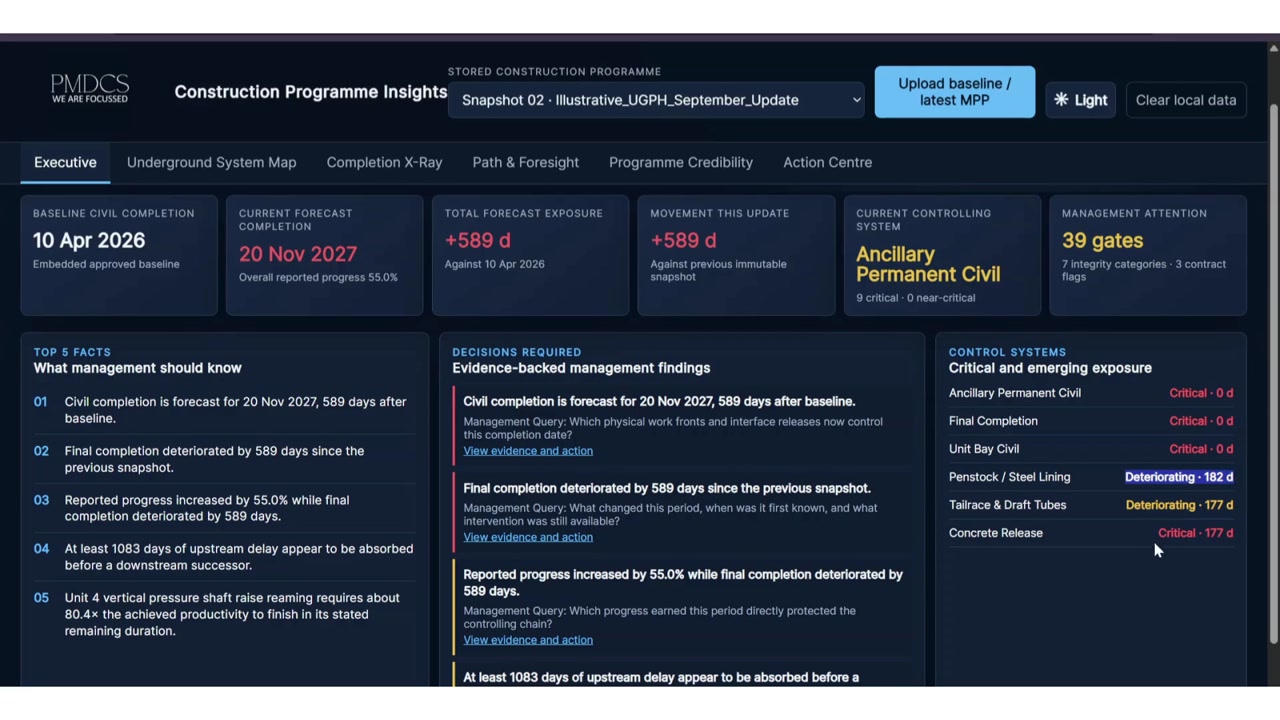
A monthly programme can report thousands of dates and percentages yet still leave management without a clear answer to four questions: Where is civil completion now heading? What system is actually controlling it? Which path is becoming critical? What action can still change the outcome?
Construction Programme Insights interrogates the schedule as a connected construction system. It compares snapshots, traces movement through logic and interfaces, and keeps the underlying activity evidence available for review.
What the application examines
- Baseline civil completion against the current forecast.
- Total forecast exposure and movement since the last update.
- Current completion-driving and near-critical paths.
- Underground-system, access, work-front, gate and interface dependencies.
- Float erosion, path convergence and delay propagation.
- Schedule-integrity warnings and implied recovery assumptions.
- Potential delay, contractual-record and claim-opportunity items requiring competent review.
- Management actions, responsibility, evidence, due dates and commitment follow-through.
How the review works
- Upload the approved baseline programme and the latest updated programme.
- Preserve each upload as a project snapshot and compare it only with that project's own history.
- Test completion movement, logic, float, gates, interfaces and controlling paths.
- Review schedule-quality warnings before relying on the forecast.
- Record management actions and follow their subsequent forecast effect.
Why access is controlled
The value of the output depends on programme structure, update discipline, status-date quality, project configuration and the interpretation of construction interfaces. PMDCS therefore screens the project and intended use before access is provided. Trial or project deployment arrangements, data handling and user access can then be agreed for the specific case.